The cop economy: confiscation, salaries and bribes
Where police money actually comes from, and why the role is designed as a paid job rather than a punishment detail.
Cops earn from a cut of confiscated goods, from arresting criminals, and from bribes that let suspects walk. Their gear is gated by badges, and their salaries and loot-earned badges were reduced on 4 November, shifting the role toward confiscation income.
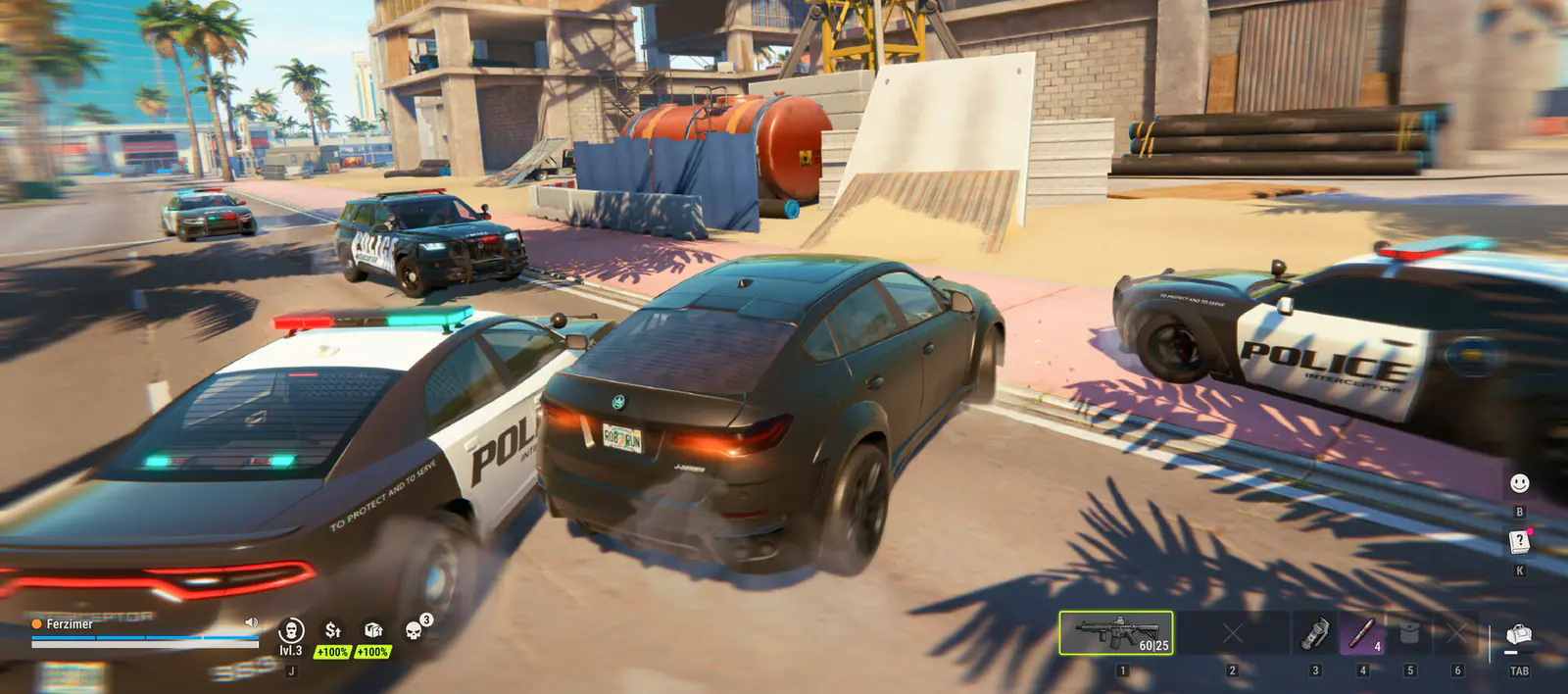
Most crime sandboxes treat police as scenery with guns. ROB RUN makes them players with a payroll, and the payroll explains almost every police behaviour you will meet in Looty Bay.
The three income lines
| Source | How it works | Risk |
|---|---|---|
| Confiscated goods | A cut of what is taken off arrested or surrendered criminals | You have to win the arrest |
| Arrests | Paid for catching criminals | Long respawn timers if you die trying |
| Bribes | Paid by suspects to walk away | Income now, reputation later |
Kefir, Gameplay Overview, 17 September 2026.
The interesting part is that these three lines point in different directions. Confiscation rewards a clean arrest. Bribes reward letting the arrest fail on purpose. A police force with both is a police force with internal politics.
Confiscation and the surrender rule
Kefir’s surrender mechanic is precise: if the police catch you, you can surrender, and the cops only confiscate what is in your bag, leaving your equipped gear intact. For a cop, that is the cheapest possible win — the suspect keeps their gun, you keep their loot, and nobody has to die.
The 4 November rebalance
- Cop respawn time increased, with an even longer delay after each consecutive death.
- Police badges can now be bought, with selection depending on the district you live in.
- Badges earned through looting and cop salaries were significantly reduced.
- On a fresh server, patrol cops only have access to pistols; better gear unlocks as the server ages.
Read together, those four changes say: police power now scales with the server’s age and with the officer’s own investment, not with how much gear they could strip from suspects in the first hour.
The balance problem the developers named
Kefir’s own framing is unusually candid: cops are meant to be a serious threat to most criminals, and the team explicitly does not want a power fantasy where one player mows down whole squads of police. That is a hard target in a game where the police are also players with their own progression.
For a cop player, the practical translation is: you are strongest in a group, weakest alone, and most valuable when you deny a criminal their bag rather than their life.
The criminal’s view of the same economy
- Your bag is the cop’s payday. Leave the valuables at the base, or launder them before you go loud.
- Surrendering costs you the bag and keeps your gear — often the correct trade.
- A bribe is cheaper than a respawn if you are carrying something irreplaceable.
- Notoriety raises your payouts and the price on your head at the same rate.
FAQ
How do cops make money in ROB RUN?
From a cut of confiscated goods, from arrests, and from bribes. Kefir lists all three in its gameplay overview.
Do cops lose their gear when they die?
The published penalty is a longer respawn timer, increasing with each consecutive death. Gear-loss rules for police are not documented in the same detail as the criminal loop.
Can I bribe a cop in ROB RUN?
Yes. Kefir states officers can take bribes to let suspects walk. The amount is negotiated between players.
How to become a cop in ROB RUN
Role selection, badges, patrol gear and the respawn timer that punishes dying as police.
ROB RUN Notoriety: levels, bonuses and the risk curve
How the heat meter works, what it pays, and why the correct play is usually to leave before level four.
How to make money in ROB RUN: the loops that actually pay
Seven income routes ranked by risk, from dumpster cash to contraband repacking, with the real numbers where sources exist.